Why Your Homemade Spice Blend Tastes Flat Compared to Store-Bought
Quick Answer: A flat-tasting homemade spice blend is usually missing balance across flavor categories (heat, earthy, aromatic, a touch of salt or acid) rather than missing quantity — store-bought blends are engineered for that balance, which DIY versions often skip in favor of just combining favorite individual spices.
All the right spices are technically in the jar, and it still tastes like something is missing compared to the store-bought version.

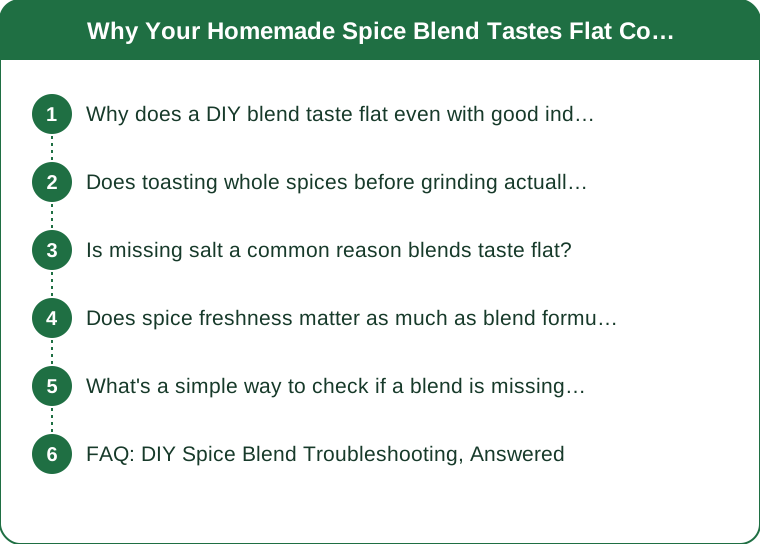
Why does a DIY blend taste flat even with good individual spices?
Commercial blends are formulated to hit multiple flavor categories in balance — warmth, earthiness, a bright or aromatic note, and often a touch of salt to tie everything together — while home blends frequently lean heavily on one or two favorite spices without covering the other categories, producing a one-note result even if each individual spice is high quality.
Does toasting whole spices before grinding actually make a noticeable difference?
Yes, significantly — toasting whole spices briefly in a dry pan before grinding releases essential oils and deepens flavor complexity in a way that pre-ground, untoasted spices straight from a jar simply can’t replicate, since much of a spice’s aromatic complexity is locked in the whole seed or pod until heat and grinding release it.
Is missing salt a common reason blends taste flat?
Often yes — many DIY blend recipes skip salt to keep the mix versatile for different dishes, but a small amount of salt in the blend itself helps tie the other flavors together in a way that adding salt only at the cooking stage doesn’t fully replicate, since salt affects how the other spice flavors are perceived, not just its own taste.

Does spice freshness matter as much as blend formulation?
Enormously — a well-formulated blend made with old, faded spices will still taste flat regardless of the recipe, since ground spices lose potency measurably within about 6 months to a year, so checking freshness of individual components before blending is worth doing alongside any formulation fix.
What’s a simple way to check if a blend is missing a flavor category?
Tasting a small pinch on its own (not in a dish) and asking whether it has warmth, earthiness, brightness, and a hint of savoriness gives a rough diagnostic — if one of those notes is clearly absent, that’s usually the specific gap to address rather than just adding more of what’s already there.
FAQ: DIY Spice Blend Troubleshooting, Answered
How much salt should be added to a DIY blend without making it too salty for versatile use?
A modest ratio, often around one part salt to eight or ten parts other spices combined, adds a flavor-tying effect without overwhelming the blend’s versatility across dishes.
Does grinding spices fresh each time versus pre-grinding a batch matter for flavor?
Freshly ground just before use generally tastes more vibrant, though pre-grinding a batch and storing it properly (airtight, away from light and heat) still outperforms buying old pre-ground spices.
Is there a risk of over-toasting whole spices before grinding?
Yes — toasting too long or at too high heat can turn desirable toastiness into bitterness, so a brief toast until fragrant, watched closely, is the safer approach than walking away from the pan.
TL;DR:
- Flat-tasting blends are usually missing balance across flavor categories, not quantity
- Toasting whole spices before grinding meaningfully deepens flavor complexity
- A small amount of salt in the blend itself helps tie other flavors together
- Spice freshness affects flavor as much as the blend formulation itself
- Tasting a blend alone first helps diagnose which specific flavor note is missing
A flat blend is usually one missing category away from tasting balanced, not a lost cause.
Keep Reading
This article is for general informational purposes only and is not medical advice. Always consult a qualified health professional for guidance specific to you.